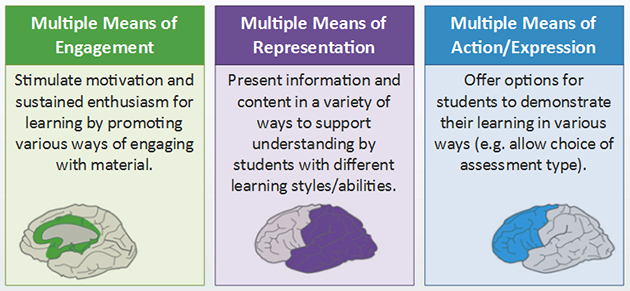
This week in EDCI 335, we explored UDL and Inclusive Learning Designs, two powerful tools when it comes to making learning accessible, adaptable, and, most importantly, an enjoyable experience for all learners. UDL encompasses 3 main means to create positive learning experiences for students: Engagement, Expression, and Representation. We have included those means into our interactive learning resource in multiple ways.
Engagement:
For engagement, our interactive learning resource gives students multiple ways to engage with the learning, both individually and with their peers. Activities such as Direct Impact of Gender Stereotypes in the Workforce and The History Behind Gender Roles use “Think, Pair, Share” to quietly reflect and inquire independently about how gender bias and stereotypes within the workforce are impactful and how they have been impactful throughout history before sharing their thoughts and findings with peers. This means of both social and independent engagement with the material allows students to gain multiple perspectives, as well as explore their own inquiries. This is impactful for the students’ learning because it promotes a more active means of learning, rather than the more passive lecture style of learning. “Think, Pair, Share” also allows students to build confidence in their learning when provided with the low-stakes environment of sharing their thoughts with their peers.
Representation:
Considering representation, our interactive learning resource provides students with multiple means of presenting the information. We provide students with visual context in the second portion of our lesson, Social Influence on Gender Stereotypes, using older advertisements, which offer multiple symbols they can recognize and recall later. We also build student knowledge by ensuring each of our subtopics and their activities can transition smoothly from one subject to another so students can use their prior knowledge and build on it. An example of this is during the transition from our first mini-lesson, Gender Stereotypes in the Workforce, where students explore specific gender stereotypes and discuss what may have caused them to think that way and our second lesson, Social Influence on Gender Stereotypes, where students explore specific examples of media curating certain gendered ways of thinking.
Action/Expression
The universal learning design ensures that students have multiple ways of demonstrating their understanding. Our lesson provides students with multiple opportunities to demonstrate their learning through communication with their peers and instructors during “Think, Pair, Share.” The lesson also gives students opportunities to demonstrate their understanding using multimedia devices, such as Padlet, or creating mind maps within groups to display what they have learned, from where they started with the first activity, to exploring how to break common gender stereotypes and confront their own biases. Our lesson ensures that it can be easily adapted to be done both with and without technology, and can be adapted easily to fit student needs.
Inclusive Learning:
Our resource ensures that all students have an accessible opportunity to learn by providing free resources that can be accessed in a classroom setting or from home. We also made sure that the learning could be done digitally or analogously, or a mix of the two. We have ensured that our lessons can be easily adapted to fit individual student needs and that student learning is centred around inclusion and collaboration. Students can do all activities independently, in pairs, or in groups, and we have made sure that the learning that is being done allows space for student choice, specifically in the final mini-lesson, Breaking the Stereotype, where students can easily choose how they wish to display their understanding and reflection in a way that best fits their needs.
Resources:
Inclusive education resources – Province of British Columbia
Hi Maya! I really like how you go in depth to what UDL means, and how it applies to your resource. It shows you have good understanding and how to apply it to your teaching methods, which I think this will make you a great teacher! I enjoy how you point out that students are given multiple ways to engage with the material, as well as numerous ways to demonstrate their understanding. This is something very important, and will work well for learners as everyone learns differently. Great read, thanks for sharing!!